
Missouri's 'Everything Tax': Why I'm Voting No on Amendment 5
A breakdown of what Amendment 5 actually does — the tax math, the loopholes, and who pays the bill.

I'm voting No on Amendment 5 on August 4.
That's not a bumper sticker. I read the amendment, and I read what the Missouri Budget Project and the Institute on Taxation and Economic Policy calculated it would do to real people's finances. The numbers are bad. The loopholes are real. And the promises supporters are making aren't in the document.
Here's what I found.






What Is Amendment 5? (And Why Is It on the August Ballot?)
Amendment 5 is a proposed change to the Missouri Constitution that would set the state on a mandatory path to eliminate the income tax — and give the legislature broad new authority to expand the sales tax to replace it, without going back to voters.
Here is the exact language that will appear on your August 4 ballot, confirmed after a legal fight that went all the way to the Missouri Supreme Court:
"Shall the Missouri Constitution be amended to: • Require legislative phase-out of the individual state income tax based on revenue growth, and authorize the expansion of sales and use taxes; • Curtail constitutional limits on taxing goods and services; and • Require local tax rate cuts without reducing school funding if local sales tax revenue increases?"
The proponents fought hard in court to remove that second bullet. Three judges said no.
One more thing you should know: this is on the August 4 primary ballot — not November. Governor Kehoe placed four constitutional amendments on the August primary specifically. Primary turnout is historically a fraction of general election turnout. The people pushing this amendment are counting on you not knowing it's there.
I'm voting No on Amendment 5. Let me explain why.
Help me spread the word. Donate today.

What Amendment 5 Would Actually Cost You
Missouri's income tax generates $8.5 billion per year and supports 64% of the state's general revenue budget — the discretionary fund that pays for schools, Medicaid, mental health services, road maintenance, and rural hospitals. That's not my number. That's from the Missouri FY2027 Executive Budget and the Missouri Budget Project.
Eliminating that revenue creates a hole. The Missouri Budget Project (a nonpartisan fiscal policy organization) ran the numbers on how we’d all be on the hook to fill it:
Option A: Raise the sales tax rate only: Missouri's current state sales tax rate is 3%. To replace $8.5 billion without changing what's taxed, that rate would need to more than triple to 10.7%. Combined with local sales taxes, you'd be looking at a 16% average combined rate. (Source: Missouri Budget Project Estimated Fiscal Impact of 26-HCS HJR 173 & 174.)
Option B: Expand what's taxed: Apply sales tax to every good and service Missourians use — doctor's visits, car repairs, haircuts, childcare, medication. Even that still wouldn't fill the gap on its own.
The Missouri Budget Project is explicit: "There is simply no realistic way to replace the income tax without expanding the sales tax to all services AND increasing the rate." Both. At the same time.
And at the end of that math, here's who comes out where:
80% of Missourians would pay more. Amendment 5 is simply a net tax increase, after accounting for any income tax savings. (Source: Institute on Taxation and Economic Policy analysis, via Missouri Budget Project.)
A median-income Missourian earning $65,400 per year would face a $535 net tax increase. That's after the income tax savings. (Same source.)
The top 20% (the wealthiest Missourians) come out ahead. High earners save more on income taxes than they pay back at the checkout line.
I'm voting No on Amendment 5. The rich get the cut. You get the bill.
The Loophole They Don't Want You to Read
In 2016, Missouri voters passed a constitutional amendment that permanently banned the legislature from expanding the sales tax to services without going back to voters. You approved it. It's in the constitution.
In 2010, Missouri voters passed a constitutional amendment banning real estate transfer taxes. Also in the constitution.
Amendment 5 overrides both protections. Here's how — directly from the bill text of HJRs 173 & 174:
"Notwithstanding any provision of this constitution to the contrary, including subsection 1 of this section… state and local sales and use taxes may be expanded by legislation to impose taxes on transactions involving any goods and services…"
The only requirement? The legislature must "expressly state" its finding that the expansion is for reducing the income tax. That's a bar they set for themselves. A sentence in a bill. No public vote. No approval from you.
The Missouri Independent described it plainly: during the five-year window, "lawmakers would be exempt from constitutional requirements that tax increases go to a public vote."
The Missouri Association of Realtors just donated $1.9 million to defeat Amendment 5, specifically because it guts both of the previous protections Missourians already voted for.
When 26,000 Realtors (according to the organization's own spokesman) across every Main Street in Missouri are spending $1.9 million to kill a bill, it's worth asking why.
I'm voting No. Voters approved those protections. This amendment takes them away without asking us.
Why Seniors and Veterans Lose on Amendment 5
This surprises people. Missouri already exempts Social Security income from state income tax under §143.125 RSMo. Missouri already exempts most public pensions — teachers, state employees, retired military — under §143.124 RSMo.
That means retired teachers, factory workers, veterans, and nurses in this state already don't pay income tax on their retirement income. Eliminating the income tax gives seniors, veterans, and pension recipients zero benefit. Nothing. Zip.
But they still buy groceries. They still fill prescriptions. They still pay utility bills.
The Missouri Budget Project says it plainly: older adults on Social Security or public pensions and active-duty military members "will have a much steeper tax increase" under Amendment 5, precisely because their income is already exempt — they lose nothing on the income tax side but pay more on every single purchase.
A senior on a fixed income cannot absorb an extra $535 a year. There is no upside for them in this amendment, only a higher bill at every checkout line.
I'm voting No on Amendment 5. Seniors and veterans have already earned their exemption. Amendment 5 hands them a higher grocery tab as thanks.
Missouri's Budget Is Already in Crisis
Before Amendment 5, Missouri's finances were already in serious trouble.
The state faces a $2 billion budget deficit — the result of a decade of tax cuts that largely benefited the wealthy and corporations, according to the Missouri Budget Project's Living on Borrowed Time report. Missouri once had nearly $8 billion in surplus reserves. By June 2027, only $4.7 million is projected to remain. (Source: KCUR, January 2026; Missouri Budget Project.)
Missouri is already one of the four lowest states in the country in state tax revenue per person — 46th by the Missouri Budget Project's analysis.
Per-capita general revenue spending, adjusted for inflation, has fallen from $2,291 per person in 2000 to $1,937 in 2023 — according to the Missouri Budget Project's analysis of Missouri Office of Administration appropriations data. We are already investing less per person than we were a quarter century ago.
Amendment 5 would blow an additional $8.5 billion hole in a budget that is already out of room.
I'm voting No on Amendment 5. The party that has held a trifecta of control over Missouri for nearly a decade has proven to be irresponsible with our tax dollars. We can’t let them increase the cost of living even more.
Help me spread the word. Donate today.
FAQ
What is Amendment 5 in Missouri?
Amendment 5 is a proposed constitutional amendment on Missouri's August 4, 2026 primary ballot. It would require the legislature to phase out the state income tax and authorize an expansion of the sales tax to replace that revenue — while overriding two constitutional voter protections passed in 2010 and 2016.
What is the "Everything Tax"?
"Everything Tax" is the name opponents have given Amendment 5 because it would authorize the legislature to apply Missouri's sales tax to virtually everything (including goods and services currently untaxed) with no public vote required.
Does Missouri’s Amendment 5 affect grocery taxes?
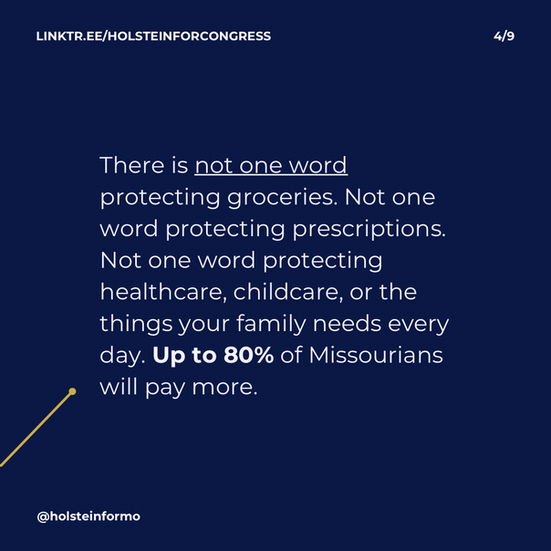
Missouri already taxes groceries at a reduced rate (1.225%, versus the standard 4.225% sales tax). Amendment 5 contains no language protecting that reduced rate — nothing stops lawmakers from raising it, and the amendment includes no exemptions of any kind for groceries, prescriptions, healthcare visits, or childcare. The Missouri Budget Project confirms the measure contains no exemptions, citing everyday purchases like doctor's visits and medication, childcare, home and car repairs, and gasoline as examples of what could be newly or more heavily taxed.
Would Missouri’s Amendment 5 raise or lower my taxes?
For 80% of Missourians, Amendment 5 would raise the new amount of taxes you pay each year, meaning you'd pay more in expanded sales taxes than you'd save from eliminating the income tax. According to an Institute on Taxation and Economic Policy analysis cited by the Missouri Budget Project, a median-income Missourian earning $65,400 per year would face a $535 net tax increase.
What happens to schools if Amendment 5 passes?
Elementary and secondary education is one of the largest line items in Missouri's general revenue budget, at roughly $4 billion a year — and the school foundation formula is already underfunded and frozen at current levels, with no increase in the latest state budget. An $8.5 billion hole in general revenue cannot be absorbed without hitting a budget where K-12 education already makes up a substantial share of the spending.
When is Amendment 5 on the ballot?
August 4, 2026 — the Missouri primary election, not the November general. Governor Kehoe placed it there along with three other constitutional amendments.